Hair Salon Front Desk Training: Scripts for the 6 Hardest Moments
Scripts for the six moments that make or break salon guest experience — from greeting to upsell to awkward price questions.
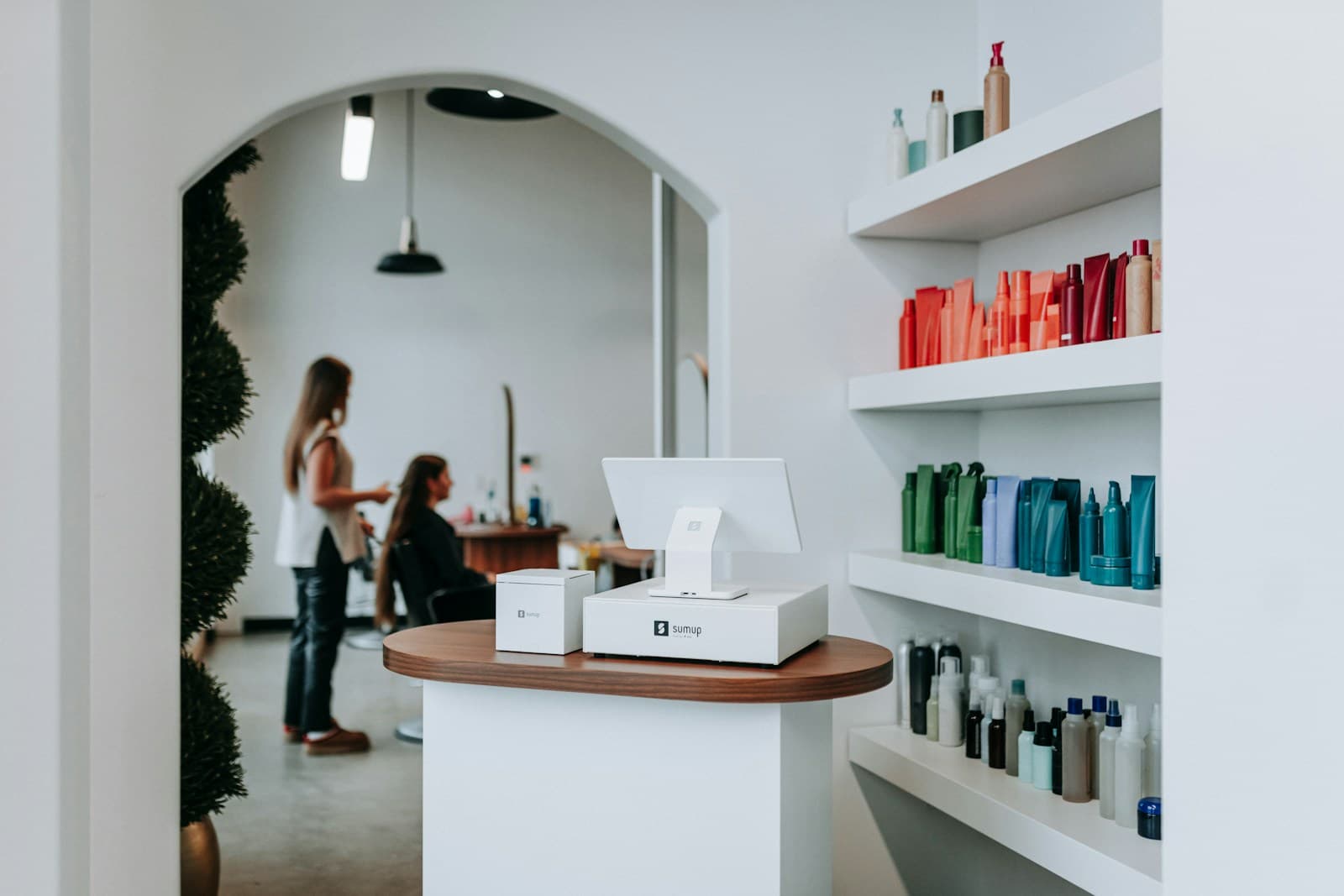
The six hardest front desk moments in a hair salon — greeting a walk-in during a full schedule, answering price questions on the phone, handling a late arrival, upselling without pressure, rebooking at checkout, and managing a complaint — account for roughly 80% of the guest experience interactions that either build client loyalty or erode it. Scripts for these moments don't make conversations robotic; they give staff a confident starting point.
Why Does Front Desk Training Drive Salon Revenue?
Front desk staff handle every first impression, every price objection, and every retention opportunity at checkout. Stylists build client relationships in the chair; front desk staff determine whether those clients book again.
A salon with 5 stylists seeing 8 clients per day generates 40 client interactions daily. The front desk staff influence the beginning and end of every one. A 10% improvement in rebooking rate at checkout adds 4 scheduled bookings per day. At $80 average per visit, that's $320 more daily revenue — from the same client volume.
Script 1: Greeting a Walk-In When the Salon Is Full
The goal: be honest about wait time without turning the client away.
Wrong: "We're fully booked right now." (Ends the interaction with no option)
Right: "We're about 40 minutes out — [stylist] should be free around [time]. Would you like to wait, or would another time work better for you? I can also check if anyone has an earlier opening."
The key elements: a specific time estimate, an option to wait, and an alternative offer. This gives the client control without forcing a yes/no on a flat-out rejection.
If your salon uses a digital waitlist or same-day booking feature, offer to add them to the digital queue and send a text when a spot opens. This captures clients who won't wait in person but will return if notified.
Script 2: Answering Price Questions on the Phone
Salon pricing is genuinely variable (hair length, density, technique). The mistake is either refusing to give any number or giving a specific number that's wrong.
Wrong: "It depends, I can't really say." (Unhelpful, loses the caller)
Also wrong: "Color is $85." (Underquotes and creates an awkward conversation at checkout)
Right: "Color services start at $85 and go up depending on your hair length and the technique — things like balayage or highlights have different pricing than single-process. When you come in, [stylist] will give you an exact quote before anything starts. Want me to book you in, or would a consultation first make more sense?"
This is honest. It gives a floor price, explains why the floor isn't the final price, and moves toward a booking.
Script 3: Handling the Late Arrival
Late arrivals need a response that is calm, fair to the stylist, and honest with the client — without being punishing.
The variables: how late, what service, whether the stylist has another booking immediately after.
Under 15 minutes, stylist has buffer: "Welcome — you're a bit late but we can still get started. [Stylist] will be right with you."
15–25 minutes, service must be adjusted: "Hi [name] — we have about [X] minutes to work with before [stylist]'s next client. We may need to simplify today's service. Let me get [stylist] to come say hello and see what we can do."
Over 25 minutes, service can't safely be completed: "I'm so sorry — unfortunately [stylist] is fully scheduled and we can't fit the full service in today without running late for their next client. I'd love to get you rescheduled — do you have availability [earliest option]?"
The key is never making the stylist absorb the consequences of a client's late arrival without consent.
Script 4: Retail Upsell Without Pressure
The in-service mention does the work. The front desk confirms at checkout.
During service (stylist or assistant): "I'm applying this frizz serum to your ends — it's what's going to keep the blowout smooth at home. I use just a pea size on dry hair in the morning."
At checkout (front desk): "Did [stylist] mention the frizz serum? I can grab one for you — it's [price]."
The client either says yes (expected) or says no (without any pressure, because the offer was already made). No hard sell. No "are you sure?" The in-service mention framed the value; checkout is just logistics.
Script 5: Rebooking at Checkout
Rebooking is the single highest-impact front desk behavior for salon revenue. The framing matters enormously.
Wrong framing: "Would you like to rebook?" (Yes/no defaults to no)
Right framing: "When do you want to come back? Your cut holds well for about 6 weeks, so [specific date range] would be the sweet spot. Do you prefer mornings or afternoons?"
By asking "when" instead of "if," you shift the client from a decision about whether to rebook to a logistics conversation about scheduling. Most clients will pick a date rather than explicitly decline.
For color clients: "Your color is going to start showing regrowth around [8–10 weeks] — want to book that now so you get your preferred time with [stylist]?"
Script 6: Handling a Complaint at the Front Desk
Complaints at checkout are the hardest moment in the front desk role. The goal is de-escalation, not immediate resolution.
Wrong: "I'll get you a refund." (Ends the relationship with no attempt to fix the service)
Wrong: "That's just how the cut turned out with your hair type." (Defensive, dismissive)
Right: "I'm sorry you're not completely happy — that's the last thing we want. Can you tell me a bit more about what's feeling off? I'd like to get [stylist] to have a quick look and see if there's something we can address today."
If the stylist is available for a 5-minute conversation, this often resolves the issue. If not, offer a complimentary adjustment appointment within the next 7 days. A resolved complaint often produces stronger loyalty than an uneventful visit.
For the broader context of running a modern hair salon, see running a modern hair salon and hair salon client retention. For operations manual templates, see hair salon operations manual.
According to Salon Today magazine's annual survey, salons that invest in structured front desk training report 15–25% higher client retention rates than those that don't — consistent with Zatrovo's own cohort data showing the rebooking rate differential.
Run your studio on Zatrovo
Book, rebook, track, and retain clients with Zatrovo's salon management platform.

We write playbooks for studio operators — based on data from thousands of studios running on Zatrovo across pilates, yoga, lash, nail, massage, salon, dance, and fitness.
Related reading
Running a Modern Hair Salon: Booking, Commissions, Growth
Real commission math, level pricing, and rebooking systems for hair salon owners in 2026.
Hair Salon Scheduling: How Buffer Gaps and Double-Booking Kill Revenue
The scheduling patterns that leak revenue in salons — buffer gaps, late cancellations, and double-booking prep — and how software fixes them.
Hair Salon Software Hub: Booking, POS, and Client Management for Hair Salons
Every hair salon software guide organized by salon type — independent stylists, multi-chair salons, and booth rental studios — with platform comparisons for each.