HYROX Classes at Your Gym: Programming, Pricing, and Booking
How to run HYROX training classes at your gym: station-based programming, race-cycle pricing, and booking rules built around your scarcest equipment.
To run HYROX training classes at a gym, use the Bottleneck Count: set class size by your scarcest race station, usually sleds, not by floor space or coach ratio. Program run-station-run blocks that follow the official eight-station order. Price the program as a 12-week race cycle tied to a real race date, and book members by station slot.
What does a HYROX race actually ask your members to do?
It is eight 1 km runs, each followed by one functional station, finishing with 100 wall balls. Program from that fixed order, not from generic conditioning.
The official race format is the same at every event. In order, the stations are a 1000 m SkiErg, a 50 m sled push, a 50 m sled pull, 80 m of burpee broad jumps, a 1000 m row, a 200 m farmers carry, 100 m of sandbag lunges and 100 wall balls. Every station comes after a 1 km run, for 8 km of running in total.
Most programming advice gets one thing wrong: HYROX is a running race with strength interruptions. It is not a CrossFit workout with some jogging. Members who come from a barbell background usually go too hard on the sleds and then fall apart on the run that follows. At the front desk, ask every new sign-up for a recent 5k time. That one number tells your coach more than a max lift does.
How do you size a HYROX class with the Bottleneck Count?
Count every race station you own, find the scarcest one, and build staggered waves around it. That number sets the class cap, not your square footage.
The procedure takes about ten minutes:
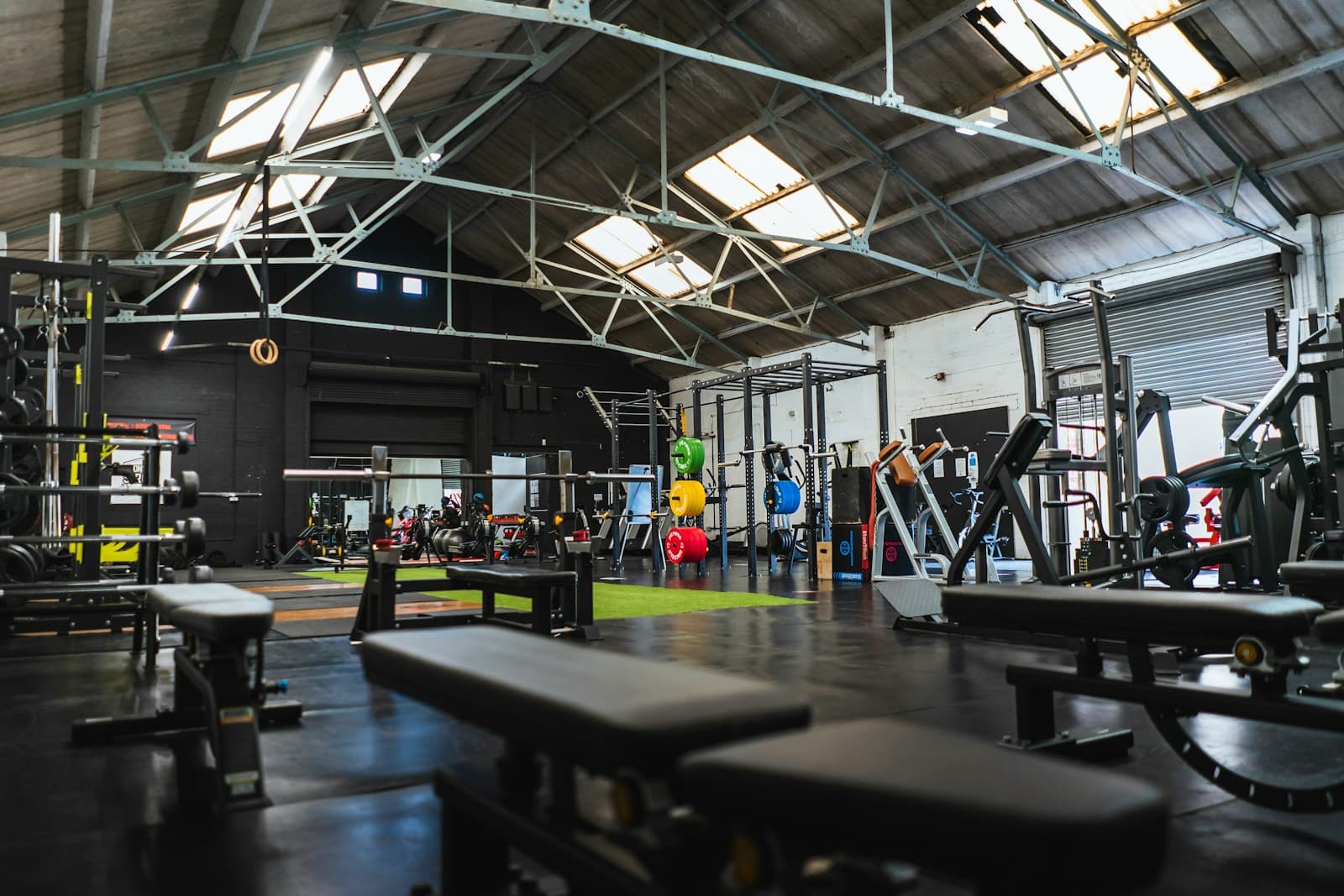
- List how many of each piece you have: sleds, SkiErgs, rowers, kettlebell pairs, sandbags, medicine balls, and wall targets with clear space under them.
- Circle the lowest number. In most CrossFit boxes that is sleds.
- Put members in pairs. One partner works the station while the other runs.
- Start each wave at a different station so no two waves are on the sleds at the same time.
Worked example: you have 2 sleds, 3 SkiErgs, 4 rowers and wall space for 8. Two sleds times one pair each gives 4 athletes per wave. Run three waves, starting at the sleds, the rowers and the wall balls. Your cap is 12.
How should a 60-minute HYROX class be structured?
Use the 10-40-10 split: ten minutes to prepare, forty minutes of run-station work on a visible clock, and ten minutes to log splits and cool down.
The first 10 minutes cover an easy 400 m run and one primer set for each of the day's stations. The 40-minute block is four rounds of a run plus a station, done at race standard or scaled. The last 10 minutes go to cooldown and writing each athlete's splits on the whiteboard before anyone leaves.
Rotate station pairs on a four-week cycle so every station comes up twice. Keep sled push and sandbag lunges off back-to-back days, because both load the same legs. Have the coach call the transitions out loud. Part of what members are practicing is going straight from a station into a run, and the race starts that run without waiting for anyone.
What do you substitute when you lack turf, sleds, or a running route?
Measure everything, convert race distances into laps of your own space, and tell members that equipment friction varies from gym to gym.
If you do not have a safe outdoor route, mark a loop with a measuring wheel. GPS watches are unreliable over short loops. A 250 m loop done four times gives you an honest 1 km. If your turf strip is 12.5 m, four lengths make the 50 m sled push.
How do you price HYROX classes without undercutting your memberships?
Sell two products. One weekly HYROX-format class is included in unlimited, and a fixed 12-week race block is sold separately with extras the weekly class lacks.
The weekly class is there for retention, so do not put it behind a paywall. The race block is where the revenue comes from. Justify the separate price with things members can see: two full mock races with timed splits, a written race-week taper, and partner matching for doubles. Offer it as one upfront payment or three monthly installments, using the same reasoning as in annual vs monthly membership pricing.
If adding the class means hiring a coach, decide how they are classified before the first session. The 1099 vs W-2 rules for fitness instructors apply to them like any other instructor.
When should a race-prep block start?
Count back twelve weeks from a real race date, start on a Monday, and close sales one week before the start.
Pick the race most of your members will enter from the official HYROX calendar, and confirm the date there before you announce anything. As a worked example, take a race on Thursday, February 11, 2027. Twelve weeks before that is Thursday, November 19, 2026, so start the block on Monday, November 16.
That timing puts Thanksgiving in week two and Christmas in week six. Make Christmas week the deload, because attendance drops that week whatever you program. Open sales three weeks before the start and close them on November 9. That week gives you time to assign waves, pair doubles partners and confirm which members have actually bought race tickets.
What booking rules stop a HYROX class from falling apart?
Book by station capacity, enforce a 12-hour late-cancel window, and stop automatic waitlist promotion two hours before class.
Every empty sled slot in a class capped at 12 shows up in the timed block. Use these rules:
- Cap from the Bottleneck Count. If you add a sled, recalculate the cap the same day.
- Late cancel at 12 hours, not 2. Members on the waitlist need time to rearrange their day.
- Waitlist auto-promotes until 2 hours before class. After that, the coach fills spots at the door.
- Paired booking for doubles. Both partners book together so they end up in the same wave.
- Collect the 5k time at first booking and use it to assign waves.
Watch attendance during the block. Two missed sessions in a row in week three is a warning sign. The steps in at-risk member detection work here too, as long as you contact the member the same day.
Can you call it a HYROX class without affiliating?
You can teach the movements without affiliating. You cannot freely use the brand. Affiliation is how gyms get the right to use the HYROX name.
Health Club Management reported in 2022 that affiliated gyms pay a yearly fee. The fee covers use of the brand name, a listing on the affiliate map, training support and coaching certifications. UK affiliations grew from 18 gyms to 120 in one year. The current fee is not published, so ask HYROX directly before you budget for it.
Until you affiliate, call the class something generic, such as Fitness Race Prep or Run-Station Conditioning. Use that name on your schedule, in your ads and on the booking page. You can still describe the eight stations, because the format itself is public.
How do you keep members after race day?
Run a debrief class within seven days of the race, and offer the next block before race day, while members are most motivated.
The first two weeks after a race are when people tend to drop off. The block is finished, the medal is on the shelf, and nothing is scheduled. Two steps help:
- The 7-day debrief. Book a single class where each athlete compares their race splits with their block mock-race splits, station by station. Most will find one weak station they want to fix.
- Offer the next block in race week, priced the same. Hold the current block price for anyone who signs up before they travel.
The US field is large enough to support that. Sports Destination Management reported more than 70,000 US participants in the 2024-25 season, so most members will have a later race to aim for.
Run your studio on Zatrovo
Cap HYROX classes by station, run paired doubles bookings, and sell 12-week race blocks from one schedule.

We write playbooks for studio operators — based on data from thousands of studios running on Zatrovo across pilates, yoga, lash, nail, massage, salon, dance, and fitness.
Related reading
CrossFit Gym Software Hub: WOD Sign-Up, Attendance Tracking, and Member Management
Every CrossFit box software guide in one place — WOD sign-up, class caps, drop-in management, and the platforms used by affiliate boxes worldwide.
CrossFit Class Scheduling: Class Caps and Peak-Hour Allocation That Maximize Coach ROI
Class cap logic and peak-hour allocation that balances member satisfaction with coach-to-revenue efficiency.

CrossFit Gym Front Desk Training: From First Call to First WOD
Scripts for the six conversations that determine whether a prospect becomes a member — from first call to on-ramp enrollment.